





In brief
- Google launched Gemini 3.6 Flash and 3.5 Flash-Lite today, with better efficiency and lower costs than 3.5 Flash—but Gemini 3.5 Pro, promised at I/O 2026 for June delivery, remains in testing after falling short on coding internally.
- 3.6 Flash uses 17% fewer output tokens than 3.5 Flash while dropping the output price from $9 to $7.50 per million tokens, making it cheaper to run AI agents at scale.
- Google confirmed it has begun pre-training for Gemini 4, which it calls "our most ambitious pre-training run yet."
Google launched three new AI models today: Gemini 3.6 Flash, 3.5 Flash-Lite, and 3.5 Flash Cyber. That wasn't what most people expected.
After unveiling Gemini 3.5 Flash at Google I/O 2026 in May and promising a Pro version within a month, Google quietly missed its own deadline. Gemini 3.5 Pro was held back because it fell short of internal targets, per Bloomberg, particularly on coding tasks. A late-June attempt to fix it by updating the training data—the massive datasets a model learns from—produced disappointing results. Alphabet stock fell roughly 4.4% on the report, erasing an estimated $200 billion in market cap in a single session.
The last Pro-tier model Google shipped was Gemini 3's successor, Gemini 3.1 Pro, back in February.
The Flash series is Google's line of speed-optimized models—fast, cost-effective, and built for AI agents, which are programs that operate semi-autonomously to handle tasks like managing documents, processing data pipelines, or browsing the web without a human clicking through each step. Pro models are the heavy lifters: slower, pricier, and built for complex reasoning where raw power matters more than speed.
What each AI model does—and who it's for
Gemini 3.6 Flash is the main release. It uses 17% fewer output tokens—tokens being the basic unit AI processes, roughly three-quarters of a word—than 3.5 Flash, per the Artificial Analysis Index. It's also cheaper: $1.50 per million input tokens and $7.50 per million output tokens, down from $9 on the output side for 3.5 Flash. For businesses running agents at scale, that difference compounds fast.
On benchmarks—standardized tests that score AI by percentage of tasks completed correctly—3.6 Flash hit 49% on DeepSWE v1.1, which tests long-horizon software engineering like building and debugging full codebases, versus 37% for 3.5 Flash. On MLE-Bench, a machine learning engineering test, it scored 63.9% versus 49.7%. It topped the table on OSWorld-Verified—a test where the AI takes control of a computer screen to complete real tasks—at 83.0%, ahead of Claude Sonnet 5 (81.2%) and GPT-5.6 Luna (72.6%).
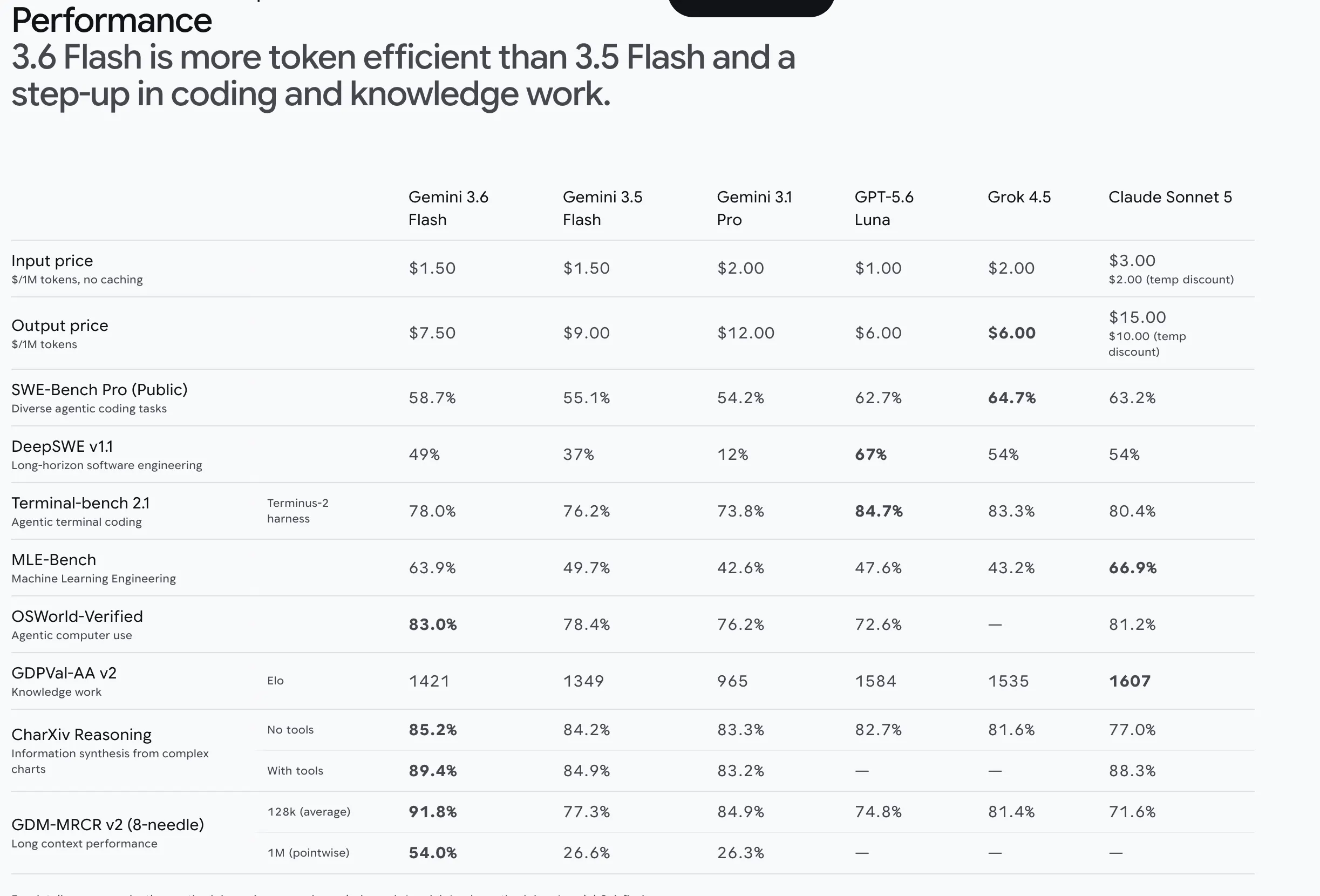
Rivals in the same category still lead elsewhere: GPT-5.6 Luna scores 67% on DeepSWE and 84.7% on Terminal-Bench 2.1, which tests agentic terminal coding. Claude Sonnet 5 tops knowledge work on GDPval-AA v2—a benchmark scored on an Elo rating scale like chess, where higher numbers mean better real-world task performance—at 1607 versus 3.6 Flash's 1421.
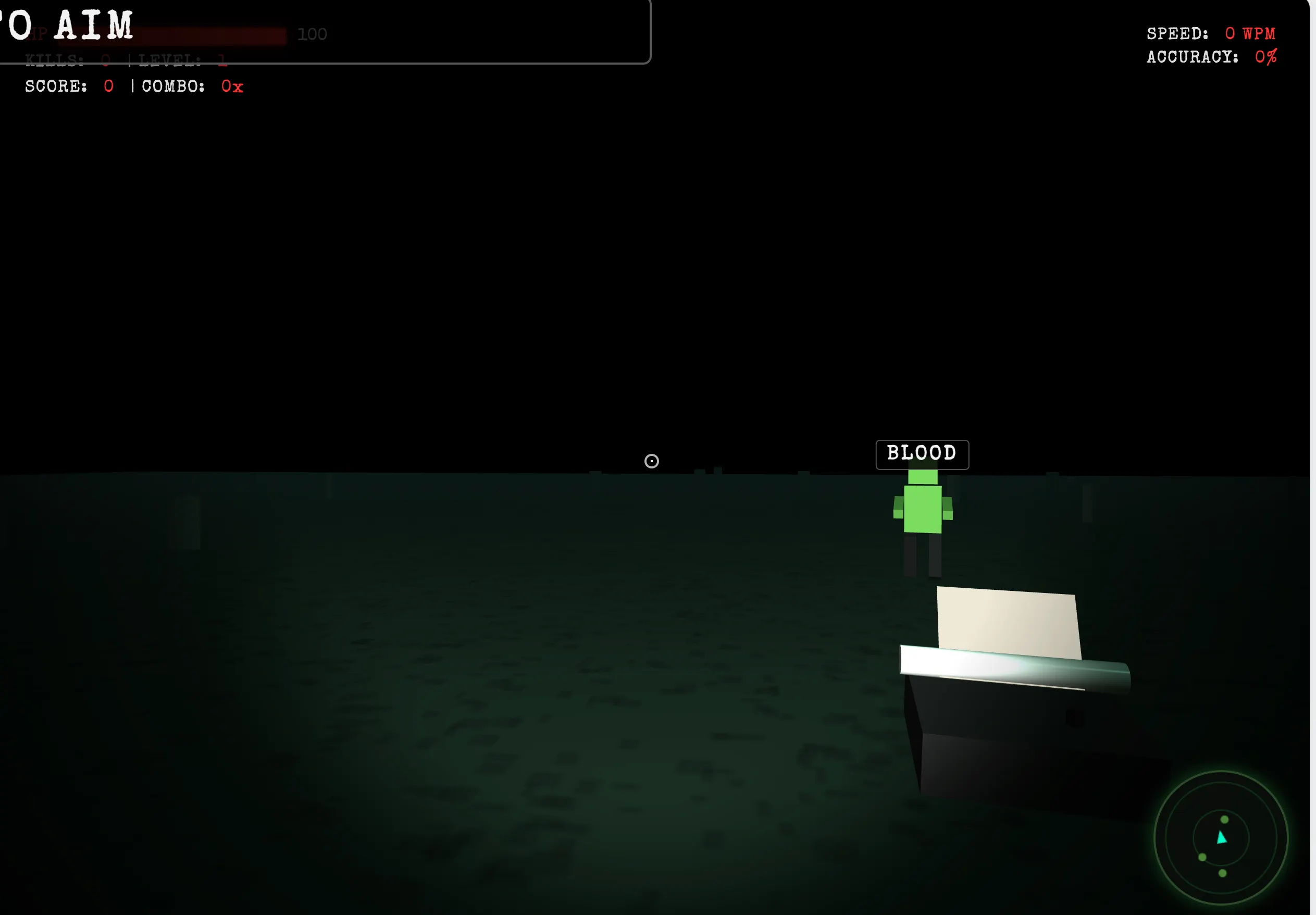
We tried the model for coding and the results were… underwhelming to say the least.
Our simple coding test ended up with an unusable file. The HTML was not properly formatted, and elements were not rendered correctly. Subsequent attempts to vibe code a way to solve the issues were not successful.
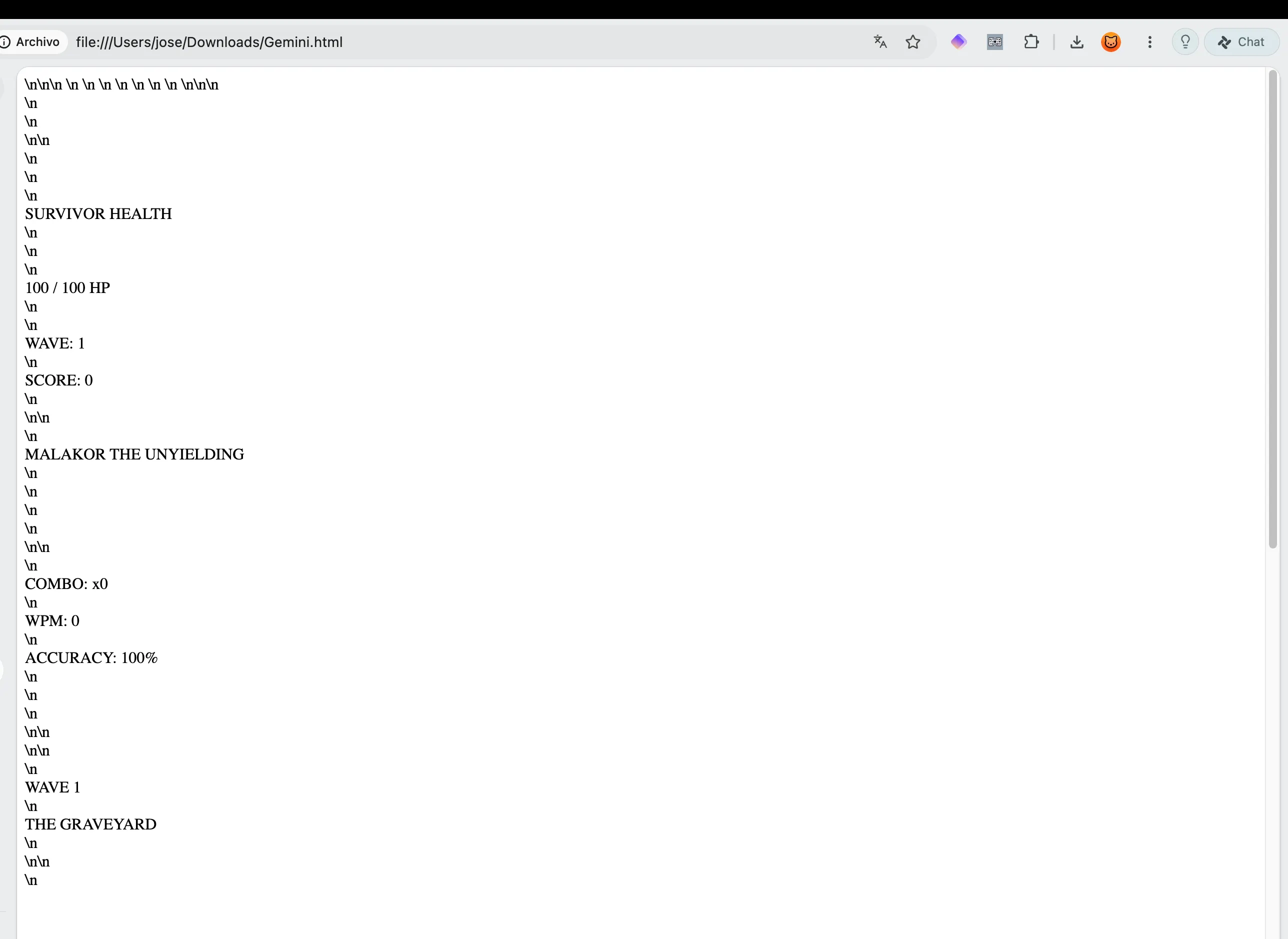
We asked Deepseek to turn the first model into something playable by simply fixing the bugs. It identified 11 bugs and implemented 8 key fixes, which resulted in a decent game.
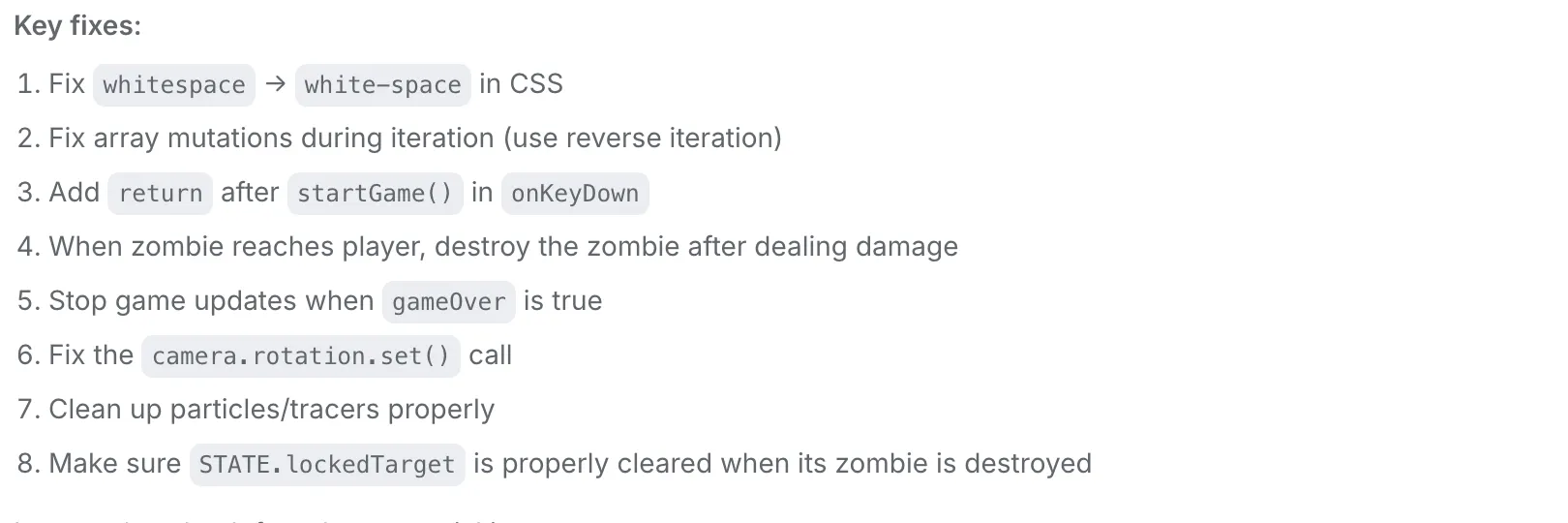
Deepseek’s small tweaks fixed the game, which means, Gemini’s core thinking was correct, but the details and inaccuracies made the result unuseful. Prepare for long vibe coding sessions with a cheap yet poor performing model if you pretend to use the model for that.
The second model released by Google, Gemini 3.5 Flash-Lite, is built purely for volume: 350 output tokens per second at $0.30/million input and $2.50/million output. It's aimed at high-throughput pipelines—think document processing at massive scale or agentic search systems—and outperforms the older 3 Flash on key coding tasks, including Terminal-Bench 2.1 (54% vs. 31%), despite being significantly cheaper.
It could also be a great session compactor (analyzing long sessions and extracting the key elements so your agent doesn’t collapse with noise) for those relying on Hermes and Openclaw.
The third model, Gemini 3.5 Flash Cyber, won't be publicly available. Google is restricting it to governments and vetted partners who need to find and fix software vulnerabilities—a dual-use capability the company is not comfortable releasing broadly.
Meanwhile, Google’s DeepMind team is already moving on. Google confirmed in the official announcement that it has started "our most ambitious pre-training run yet, for Gemini 4," and the team is already hyping it up.
Pre-training is the foundational phase where a model learns from massive datasets before task-specific fine-tuning begins—meaning Gemini 4 is being built, not planned.
We have started our most ambitious pre-training run yet, for Gemini 4, and are excited by the progress : )
— Logan Kilpatrick (@OfficialLoganK) July 21, 2026
Both 3.6 Flash and 3.5 Flash-Lite are live today in the Gemini app, Google AI Studio, and via the API. Gemini 3.5 Pro will ship, per Google, "as soon as it's ready," whenever that is.